Neighborhood Luxury: When hotels choose to belong, not to dominate
Before luxury becomes impressive, it is already present.
Before the room rate is revealed, before the concierge nods in recognition, before the view opens from a freshly drawn curtain, something has already arrived: a quality of belonging that cannot be designed from the outside. It can only grow from within.
In the Caribbean and Latin America, this truth is not a trend. It is a law of gravity. A traveler does not simply enter a hotel. They enter a social world already in motion and the most refined properties have always understood that the highest compliment is not a five-star rating, but being spoken about by locals the way one speaks of a beloved neighbor.
Here, luxury does not announce itself. It settles. It remains. The most powerful hotels in this part of the world were not built as monuments. They were woven, gradually, into the skin of their cities. They absorbed the sounds of the neighborhood, the rhythms of local life, the textures of street-level humanity and in doing so became something no imported marble could replicate: a place of authentic meaning.
In this philosophy, luxury is not dominance. It is integration. Not arrival, but belonging. Not the hotel towering over the city, but the one without which the city could not imagine itself.

The hotel as neighbor, not monument
There was a time when luxury hotels arrived as statements, glass towers, marble lobbies, a geometry of power asserting its difference from the surrounding world. Walls that said: we are not of this place. We are above it.
But in the most authentic corners of the Caribbean and Latin America, a quieter idea has taken root over generations. The best properties here did not compete with neighborhoods. They completed them.
A hotel becomes part of a neighborhood the way a mature tree becomes part of a landscape, quietly, naturally, with presence rather than performance. It is a place where weddings spill into plazas, where baptism photos echo beneath arcades, where residents gather for anniversaries, graduations, and long Sunday lunches that drift into evening without apology.
These hotels do not measure their value in exclusivity. They measure it in the depth of relationships. In how many generations have celebrated here. In how many first dances have unfolded in that hall. In how many children have grown up knowing that courtyard as a second home.
In this vision, luxury is not measured by how many people a hotel impresses, but by how many it holds.
Where social life converges: the hotel as the city’s living room
Some hotels become extensions of the social fabric, spaces where life happens, not just where travelers sleep.
In the Caribbean and Latin America, these properties are trusted venues for quinceañeras: the ballroom where three generations dance at a family wedding, the lobby where business partners become friends over a long afternoon, the bar where locals toast victories and sit in silence with losses. These are not interchangeable spaces. They are chosen with the seriousness reserved for things that matter.
A couple does not choose such a hotel for a rehearsal dinner because it has the highest online rating. They choose it because their parents celebrated there. Because a grandmother remembers the dessert. Because something invisible but real lives in the walls a continuity of human emotion that cannot be installed by an interior designer.
These hotels do not compete with neighborhoods. They complete them. They become luxury not by separating from the city, but by becoming its quiet heartbeat, the place where life’s most emotional chapters are entrusted with confidence.
Designed belonging: architecture that opens, not closes
Neighborhood luxury begins with architecture that participates.
Not architecture that performs, not buildings that announce their importance, but physical spaces that understand their relationship to what surrounds them. The difference is immediately felt, even if it cannot always be described. Instead of walls that forbid, these hotels offer wide verandas that breathe into the street. Open lobbies that blur the boundary between inside and outside. Cafés spilling onto sidewalks as if the city were another room. Courtyards designed for community, not spectacle.
And the most remarkable go further. They do not only open façades to the city. They speak its visual language. Colonial stone in Cartagena, tropical wood in Santo Domingo, Art Deco curves in Havana, volcanic stone in Guatemala. Architecture remembers the ground beneath it. Design becomes diplomacy. Architecture becomes a handshake across centuries.
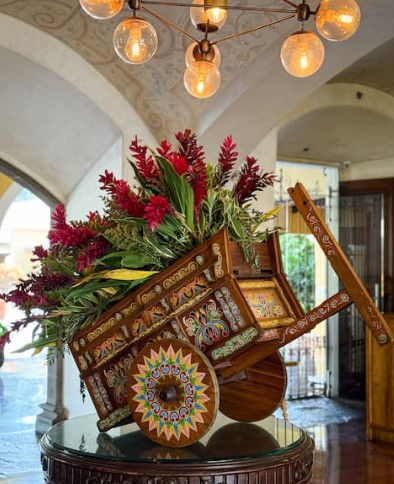
Cuisine as common ground: kitchens that feed the community
A hotel that belongs to its neighborhood does not serve anonymous cuisine. Its kitchens are not neutral. They have a point of view, a relationship with the city, a loyalty to local producers and inherited recipes. Breakfast draws professionals from nearby offices. Lunch welcomes families celebrating milestones. Dinner attracts residents who trust the chef more than global trends.
But it goes deeper than comfort. Menus tell the soul of the neighborhood: Costa Rican coffee roasted by a producer known by name, Mexican pastries following inherited recipes, Caribbean cocktails built on local botanicals, spices carried forward from markets across generations. Luxury here is not elevated globalization. It is elevated local affection.
Events as emotional geography
There are places that do not exist only in space, but in people’s time.
In hotels that truly belong to their neighborhoods, every event is never just an event. It is a trace that remains, an emotional imprint left on surfaces, corridors, and shifting light across the years.
The ballroom is never just a ballroom. It is the place where a woman once stood in a white dress, trembling slightly before stepping into an irreversible moment. It is where a father tried to remain strong while walking his daughter toward a new life. And years later, it is the same space where that daughter repeated the gesture from the other side of time.
The photo garden is never just a garden. It is where afternoon light has imprinted itself on hundreds of smiles, some sincere, some emotional, some carefully held back. It is where boys become adults for a moment, while parents watch with a quiet nostalgia that needs no words. The terrace of toasts is never just a terrace. It is where glass reflections have held promises, victories, departures, returns. It is where life, for an instant, seems to pause just long enough to be recognized.
In these spaces, luxury is never scenery. It is layered memory.
And so the hotel becomes something rarer than a place of hospitality: it becomes an emotional archive of a community. A place where life is not only welcomed, but preserved.
Staff as cultural anchoring
In some places in the world, luxury is also measured by what changes. Here, it is measured by what remains. There is an invisible form of elegance that lives not in materials, but in faces that age through decades without losing their quiet purpose.
The doorman who knows every entrance is not simply opening a door. He is recognizing a story. He can distinguish first-time guests from returning ones, even when no visible trace of time exists. And that recognition, subtle, almost imperceptible, is a form of hospitality no digital system can replicate. The waiter who remembers families’ favorite desserts is not memorizing orders. He is preserving emotional habits. He knows a certain dessert is not just taste, but tradition, repeated every year, at the same table, even when someone is no longer there.
The coordinator who has organized weddings across two generations is not managing events. She is moving through a family’s history like an invisible thread connecting past and present. She has watched roles transform: children becoming spouses, spouses becoming parents, parents becoming memory. The bartender who knows the neighborhood by name is not serving drinks. He is listening to confessions, light and heavy, celebrated or unspoken, repeated or new.
These people are not simply part of service. They are part of the place itself. They are the reason the place never truly shuts down. They are continuity made human.
When global and local meet
The true balance is not perfect fusion. It is living tension.
In hotels that belong to their neighborhoods, the world arrives, but does not erase. It enters, but does not overwrite. It brings standards, but does not replace local soul.
The international traveler finds familiar comforts, but slightly shifted, slightly reinterpreted, as if someone had taken what they knew and immersed it in a different light. Warmer. Slower. More human. And in that difference, something subtle happens.
It is not adaptation. It is not imitation. It is cultural translation.
Breakfast may have the precision of an international hotel, but the rhythm of a Caribbean city. Service may meet global standards, but carry a gentleness unique to that place. Design may follow contemporary luxury codes, but speak a language made of local materials, natural light, and architectural memory. The traveler does not simply feel welcomed. They feel displaced, gently, deeply, into another possibility of the world.
And they return changed, even if they cannot explain why.
The definition of neighborhood luxury
Here, luxury stops being a position and becomes a relationship. It is not what you own. It is what you recognize. Not distance. Chosen proximity.
Not perfection. Continuous belonging.
Hotels that choose to belong do not simply host people. They pass through them. They enter their stories without invading them, and leave enriched without consuming them. They become places not only visited, but remembered with a particular tenderness, the kind reserved for things that were part of one’s life without asking anything in return. And so the future of luxury in the Caribbean and Latin America will not be a race toward bigger, more spectacular, more flawless. It will be a return.
A return to something slower, deeper, more human. A luxury that does not impose itself, but grows. Not built, but cultivated. And for that very reason, never truly ends.
And perhaps this is the real secret of these places.
That at some point, you can no longer remember the first time you were there. Because there is no first time anymore. Only return. As if the hotel never waited for you, but had always known you.
As if its rooms had learned your steps before you arrived.
As if, among all the cities in the world, right there, in that exact space between a street and a memory, someone had already decided you would come back.
And you, without even knowing it, have always accepted the invitation...
____________
Author: Saluen Art


Comments