Two shores of the same dream
Cartagena & the Rosario islands
A city that does not simply exist, but breathes against your skin
If I had a different life, I would be Selemio.
And in that life I would arrive in Cartagena as one enters a living memory, not to visit it, but to be carried through it.
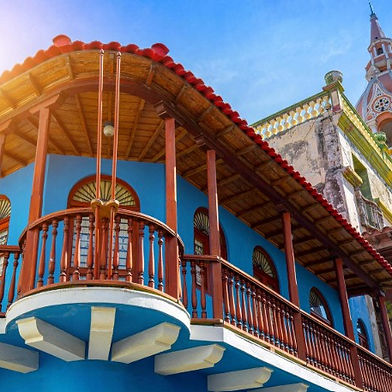
Because Cartagena does not announce itself. Cartagena takes you in gently and holds you there. The moment I pass through the walls, I feel the heat rising from the stones like an ancient breath. The air is dense, almost golden, as if it carries the weight of stories. The pastel façades are not just buildings: they are solidified emotions. Faded pinks, soft yellows, blues that have learned how to resist time.
Balconies overflow with bougainvillea, falling as if the city does not know the word “order,” only the word “life.” And I understand immediately that here, luxury is not an addition. It is a form of memory that has never stopped living.
Cartagena is a city that has endured pirates, trade, slavery, revolutions, and carnivals. And instead of hardening, it learned the rarest skill of all: transforming everything into beauty without ever losing its soul.
I walk slowly, with the sensation that every stone recognizes me.
Inside the walls: where time has not been erased, but preserved
In the historic center, time has not been stopped. It has been listened to.
The cobblestone streets still seem to carry the footsteps of those who passed centuries ago. Massive wooden doors open onto hidden courtyards where water flows slowly, as if in no rush to arrive anywhere. The Cathedral of Santa Catalina appears suddenly, imposing yet never cold, like a presence that does not seek to dominate but simply to remind.
And then there is the silence of the Convent of San Pedro Claver, which is not empty but filled with something I cannot immediately name. Perhaps compassion. Perhaps history. Many hotels rise within these ancient spaces. And to sleep here means one thing only: accepting that the past is not behind us, but beneath the skin of the rooms.
I lie down in a room that once may have been a cell, a refuge, or a promise. And I realize that the deepest form of luxury is this: not being separated from history, but being inhabited by it.
Getsemaní: color as a declaration of identity
Then I step beyond the walls, and Cartagena changes its voice. Getsemaní does not ask permission. It tells its story. The walls are covered in murals that do not decorate, they speak. They tell of bodies, struggles, celebrations, Afro-descendant memory, pride, resistance. Every corner seems to vibrate.
Champeta music arrives before the people do. It is a rhythm that is not merely heard, but entered. And I find myself in a street where life is not contained. It is free. Here I understand that color is not aesthetics. It is identity.
A different kind of luxury emerges in this neighborhood: not perfection, but truth. The truth of the streets, of loud laughter, of barefoot children running, of vendors turning everyday life into performance. And I am no longer looking at Cartagena.
I am living it.
The taste of the coast: when the sea becomes cuisine
In Cartagena, the sea is not only eaten. It is remembered. The first bite is always an encounter. Cold ceviche cutting through the heat like a sudden light. Arepas de huevo bursting under your teeth like small surprises. Mote de queso tasting of earth and home at once.
And then posta cartagenera, slow, sweet, spiced, as if each bite had crossed centuries before reaching the plate. I sit on a terrace overlooking the city’s rooftops and realize that here, food is not service. It is storytelling. Every flavor carries a place, a gesture, a hand.
And as the sun lowers, everything softens. Even time.
Kindness as invisible architecture
But what truly remains of Cartagena is not only what is seen or tasted, it is the way care is given. A cool towel when the heat becomes intense. A smile arriving before the request. A name remembered effortlessly. A door opened as if it were the most natural thing in the world.
Hospitality here is not an act. It is a language.
And I realize that in this city, the rarest luxury is not being welcomed. It is being recognized.
The passage: when the city dissolves and only the sea remains
Then comes the moment of leaving Cartagena. I board a boat and the city slowly recedes, like a dream that does not fully want to wake. The domes become dots, the walls a thin line, the sound a memory. Ahead of me, the sea opens. And the sea does not speak immediately.
It waits.
The Rosario Islands: when the world stops rushing
The Rosarios emerge on the horizon as if someone had gently scattered them across a sheet of water. Here, blue is never just one. It is a language made of impossible shades.
The moment I arrive, everything slows down. Not because it is asked to, but because it cannot do otherwise. The water is so clear I feel as if I am floating inside light. Fish move like thoughts. Mangroves breathe slowly, as if they know the secret of time. I lie in a hammock suspended above the sea and understand that here, luxury is disappearing without being lost.
The ritual of the sea: living inside slowness
Days in the Rosarios are not counted. They are lived through. You swim among corals like inside a submerged cathedral. You listen to silence that sounds like water. You eat freshly caught fish that still tastes of movement. Sunsets do not arrive. They happen.
And night does not fall. It settles. Every gesture becomes simpler: breathing, swimming, watching, staying. And I realize I am forgetting hurry without having to fight it.
Two souls of the same breath
Cartagena and the Rosarios are not two destinations.
They are two ways of feeling. Cartagena is the heartbeat: warm, human, layered, full of voice. The Rosarios are the breath: transparent, slow, deep, weightless. And between these two extremes, something like balance is born. A rare kind of luxury that does not ask you to choose, but to move. From city to sea. From noise to silence. From history to presence.
The luxury of this land
When I leave Cartagena and the Rosario Islands, I understand that the journey never truly had a boundary. There is no point where it ends and another where return begins. Only a slow fading, as if the world had decided not to fully close itself behind me.
Cartagena remains like a flame that no longer burns but continues to illuminate. I feel it in the colors that return without being called, in the sounds that resurface in quiet moments, in the way life suddenly feels a little more intense than before. The Rosario Islands, instead, do not remain as an image. They remain as absence. As a form of stillness I had never encountered and now recognize everywhere it is missing.
And between these two opposing presences, the heartbeat and the suspension, the voice and the silence, I realize something has shifted inside me without noise.
Perhaps this is the real luxury.
Not taking a place with you. But letting yourself be taken by it, enough to never return exactly the same. And while everything continues elsewhere, inside me Cartagena keeps speaking. And the sea of the Rosarios keeps breathing.
As if both had decided they no longer need to be visited.
Only remembered